Friday, May 11, 2012

Happy Mother's Day


In honor of Mother's Day, I'd like to re-post a blog I did last year called Mom's Trees. 
Happy Mother's Day Mom...I miss you.
The summer that my mom died in 2005, my sister and dad and I took a drive to Ouaquaga, New York to see my mom's childhood home.  Across the street from the house on what was their land were two lovely trees in front of a vineyard.  Of the many photos I took that day, this one ended up as the desktop photo on my laptop computer.  Of course each time I turned on my computer, I thought of my mom, and so these trees became for me, "Mom's Trees."                                     

Early this summer--my first summer in our new home here in Lake Arrowhead--I was sitting at my desk in front of my open laptop looking out the window, and this is what I saw in my yard below: Two trees identical to those in the photo on my computer!  The trunks of each tree branch similarly to Mom's trees.  The one on the left has two trunks that each branch in a Y.  The one on the right has a thin trunk and a thicker trunk. 

I hadn't noticed them before because when we moved here, they were leafless, and then in spring, the tree on the left was covered in pink blossoms. Now that the blossoms were gone and both trees had filled out, the similarity was quite amazing.  I sat for a few moments glancing first at the laptop photo and then back out the window until I ran to get my husband and then my camera. (If you click on the pictures to enlarge them you can see what I mean.)             
                     

So now each day, as I sit and write and look out my back door, I see Mom's Trees, and they make me feel, more and more, like I'm home.

Monday, April 30, 2012

Nature Red in Tooth and Claw...and Beak


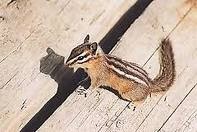
Oh my.  As I was watching two cute, tiny little chipmunks on my deck, it dawned on me--that's what my raving ravens were eating on top of my neighbor's barbecue.  Not a mouse or a rat, but an adorable chipmunk.  Oh my.  But then I had to remind myself that while chipmunks are the prey of many mammals and birds, they are also predators themselves, often raiding a nest of bird's eggs or nestlings. Oh my. 

Saturday, April 28, 2012

Raven Update: I hope my neighbor doesn't see this!

(If you haven't read the previous entry: My Raving Ravens are Back, read that first as this is a follow-up to that one.)
I returned from a 2 week trip to find the female raven in her nest, while the male is always very close by.  There must be eggs as she stays there all the time now.
She is stretched out along the back of the nest.


He sits in one of several trees beside the house.
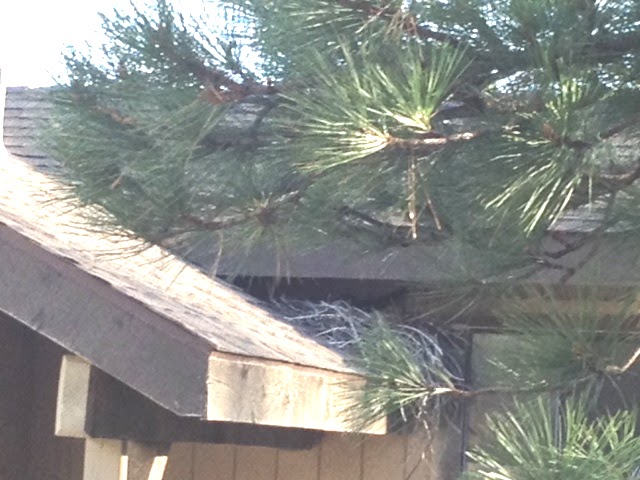
(Her nest is in the right corner of the photo.)

Or he perches on a telephone pole beside the nest house. 
 I wondered if she ever left the nest at all and how he fed her. Then this afternoon about 3PM I saw two ravens on the neighbor's deck, or should I say on his barbecue, eating what I think is a mouse or rat.  I looked into the nest to find it empty. So it was them.                                                     
 
He let her eat first.
            

Then when she flew back to the nest, he finished the leftovers.
                     Hope he gets those last morsels on the barbecue top! Yuck!

(Still on raven watch. To be continued....)

Friday, April 20, 2012

My Raving Ravens are Back!

                               
                                     Raven on the railing of my deck just outside the kitchen window.
Last year I began my blog with the delightful antics of a raven family that kept us entertained all summer.  (Check out Raving about Ravens July 2011.) The youngsters have grown and flown the coupe but the Ma and Pa, who mate for life, are still here, and to my excitement (yeah, I don't get out much), they built a nest across the street under our neighbor's roof.
                               
                                 Not the clearest picture but you can see her curled up on the nest.
The two of them fly all over the neighborhood calling out to each other; they're always together or at least within cawing range.  They even started hanging out on the neighbor's deck again.  (It won't be long before he sets up the scary owl, I'm sure.)
                              

But one windy, rainy weekend near the end of March, I noticed a tarp had been placed on the roof in such a way that it covered the nest. In fact, it flapped so much in the wind, making such a racket, I was certain the ravens would abandon the nest. 
                                      

About a week later while walking my dog, I glanced at the nest and noticed some movement.  She was still there! You can see her beak sticking out just under the roof's edge below.
                                       

She is there daily but comes and goes, so I'm not sure if there are eggs yet.  Once she does lay eggs, incubation is 20-25 days and then nesting from 28-50 days.  So it will be awhile before I see the new family flying about. 

I plan to follow them through the season and keep you informed!

For more basic info on ravens:
http://www.allaboutbirds.org/guide/Common_raven/lifehistory

Wednesday, April 18, 2012

Found the Next Chapter in My Life: Working with Wildlife


Coyotes by my house in Lake Arrowhead

Recently I began studying the wildlife commonly found in the San Bernardino Mountains: Black bears, mountain lions, mule deer, bobcats, coyotes, foxes, and magnificent birds of prey,  just to name a few.  I thought that by understanding their habits and habitat, I could come to enjoy and respect their presence, as well as avoid any foolish mistakes that might endanger their lives or mine.  
Having done this with horses, I learned the value of “thinking like a horse” which makes working with them easier and loving them richer.  Rather than projecting human thoughts and needs and fears into their heads, I want to be aware of what brings them pleasure and comfort, what piques their curiosity, or what scares the bejesus out of them.  A filmmaker may find beauty in an air-born plastic bag (American Beauty), but any horse-owner will tell you, a white bag blown about by a gentle breeze is as terrifying to a horse as a stalking mountain lion.  Maybe worse for, What the hell is that thang?
In addition to reading some great books on wildlife (I’ll post a list soon), I also began training as a Wildlife Care Provider at Wildhaven Ranch a wildlife sanctuary near Lake Arrowhead, and with that new responsibility, I began visiting local zoos and talking with zookeepers and curators as well as vets.  As a result, I discovered not a hobby or part time activity but a burning fascination that is clearly the next chapter in my life: Working with wildlife in captivity. 
Orphaned 6 month old mountain lion at Orange County Zoo

I used to have a problem with zoos; seeing animals in captivity broke my heart.  But I came to learn that most animals in zoos and sanctuaries cannot be released into the wild.  Some would not survive due to injuries and disabilities, such as a hawk with a broken wing; others because they are human habituated.  While rehabilitation facilities strive to rehab and release, some animals become imprinted on the humans that care for them and cannot be successfully placed back in the wild.  Animals orphaned at a young age are often brought to facilities where they are hand-fed and cared for and thus become imprinted on their caretaker.  Others are former “pets” of people foolish enough to think a cute little bobcat or fawn could be a part of their family.  Some are former “performing” animals bred and raised for this purpose, and others are actually born in captivity.
So here they are, living their lives in a zoo or sanctuary; why not make it the best life they can have?  Amazing changes have taken place since I was a little girl visiting a zoo and seeing tigers in small cages.  Not only have the exhibits been improved to provide the animal with a more natural habitat, but care providers work hard to enrich the lives of their animals in other ways to keep them active, stimulated and challenged. 
 I am so excited about my new venture.  I have met fascinating people devoted to their work, and most importantly, I've become acquainted with some amazing animals.  There is nothing like looking into the eyes of a black bear or a mule deer--up close and definitely personal. 
 So expect to be reading everything I learn or experience as I pursue my new passion.
Mule deer at Wildhaven Ranch

Spectacled Bear at Binghamton Zoo


Tuesday, November 29, 2011

European Starlings in America: Innocents Abroad or Lord of the Flies?

In my last post, I mentioned seeing a mysterious new species of bird at my feeders.  On further research, I discovered that they are European (English) Starlings.  And wouldn't you know, they are here because of the famous Englishman William Shakespeare and an infamous American Eugene Schieffelin, a gentleman who, in the name of art, tampered with nature and caused a major disaster. 

Apparently as president of the American Acclimatization Society, Schieffelin came up with the brilliant idea of introducing to America every bird species mentioned in the works of the great bard.  In 1890, he released about 60 starlings to Central Park--and there are now somewhere between 140-200 million!

According to an article on "invasive species" (which says it all), "Starlings are among the worst nuisance species in North America. The birds travel in enormous flocks; pose danger to air travel; disrupt farms; displace native birds; and roost on city blocks. Corrosive droppings on structures cause hundreds of millions of dollars of yearly damage. In 2008 the U.S. government poisoned, shot or trapped 1.7 million, the most of any nuisance species."   

Welcome to America! 

Actually, if you think about it, they do exemplfy the American Dream.  Wrenched from their homeland and plucked down in the heart of New York, they have managed to survive and thrive from sea to shining sea.  They are driven and determined little creatures, letting nothing, not even the U.S. government, get in their way.  

So it is no surprise that even on the foggiest, windiest day up here in the San Bernardino Mountains, in the pouring rain, with temperatures close to freezing and soon to bring snow, these hardy birds were the only ones at my feeders a few weeks ago, polishing off what seed was left. 
I do admire their pluck and tenacity though their fierce spirit can be intimidating.  I can't help but wonder if their ancesters in Europe were quite as intense or if this is a result of assimilation in America.

Perhaps it's time for a name change?   This new species of  European Starlings might be more appropriately known as  American Starlings.  What do you think?

For more information:
http://natureali.org/european_starling.htm
http://icwdm.org/handbook/birds/EuropeanStarlings.asp
http://en.wikipedia.org/wiki/Common_Starling

Saturday, November 12, 2011

Feed Them and They Will Come or Lakeview Dining Open Year Round

                                
My last blog ended with my questioning what birds, if any, would stick around once winter set in.  I got my answer just last week!  On November 4th we had our first snow--just a couple of inches, but enough to give us a taste of winter, and enough for me to learn about our birds' migrating habits.
And what I learned was that if you continue to put food out for them, they will stick around.  In fact they will throng to your feeders and eat together, or should I say elbow each other aside for the best seat.  No more pecking order, unless something really large, like a raven or a band-collared pigeon swoops down, but generally they eat side by side. 
Northern Flicker with a Purple Finch

Mountain Chickadees and Finches

Lesser Goldfinch with Flicker

Even my tiny Lesser Goldfinches returned to the wind socks
 and if you look at the hummingbird feeder to the right of the water bowl, you will see a hummingbird  perched on the side.  In fact, I have never seen so many hummingbirds at this feeder since the weather turned.   Now that there are no flowers to feed from, I guess they'll be coming here.

This little one tried to get a drink from the frozen bowl of ice, then hopped down to the snow below and pecked away at that.
Since then, my husband and I take turns chopping through the ice in the bowl if it's just the top layer or adding warm water to melt it.
I talked to a few locals who are knowledgable about birds and asked if I am putting my birds in danger by providing food when the temperatures dip below freezing.  All reassured me that they wouldn't stay if they couldn't survive, plus they are just a day's flight or less down the mountain to warmer climate. Just when I thought I'd be spending less money on bird food each month, I am buying more.  I now have more birds than ever!

...and even a few  newcomers.   I am not sure what this bird is, although I'm wondering if it's a young Northern Flicker.  Does anyone out there know?  I've looked through my books and can't find it.  It does resemble the flicker a bit and as my husband pointed out, the tail feathers don't look fully developed. 
All I know is that they come in small groups daily.
                                                                                                 
I am curious to see if they will all continue to enjoy fine dining at my lake view restaurant once winter really settles in.  We'll soon see.